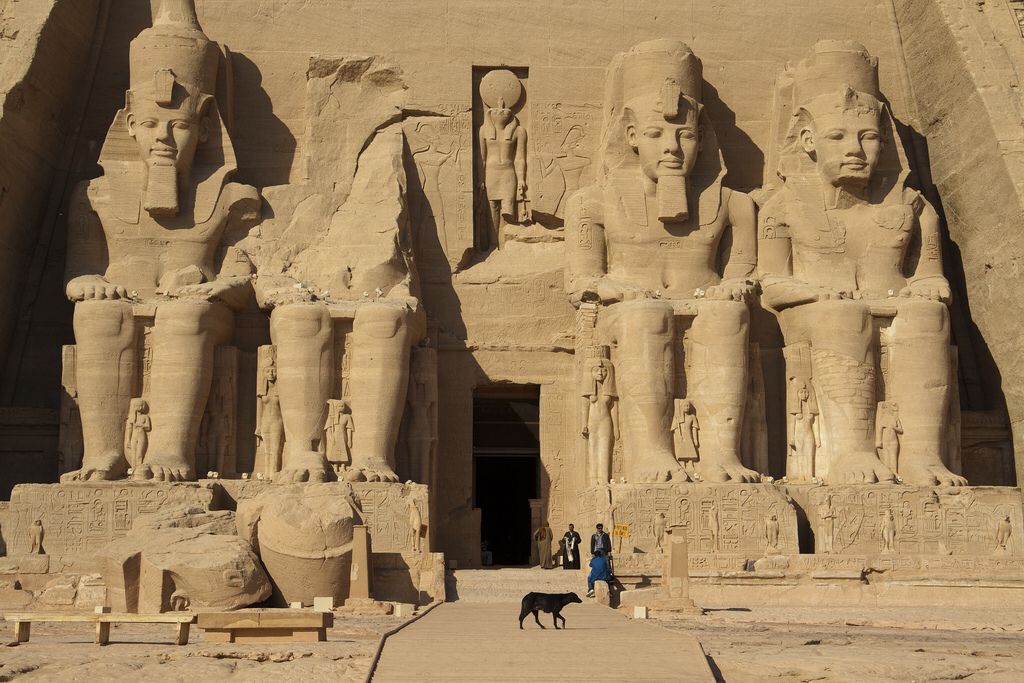
Abu Simbel refers to a pair of massive rock-cut temples in southern Egypt, commissioned by Pharaoh Ramesses II around 1264 BC. The main temples are the Great Temple,
dedicated to the gods Amun-Ra, Ra-Horakhty, and Ptah, and the smaller temple dedicated to Goddess Hathor and Ramesses II's wife, Nefertari. The temples are most famous
for their colossal statues and for the unique astronomical alignment in the Great Temple, which allows the sun's rays to illuminate the inner sanctuary twice a year. In the
1960s, the temples were moved to higher ground to save them from being submerged by the creation of the Aswan High Dam and are now a UNESCO World Heritage Site.
Dedicated to the gods Amun-Ra, Ra-Horakhty, and Ptah.
Features four colossal statues of Ramesses II on its facade; the head of one statue collapsed from an ancient earthquake and its fragments are still visible.
The interior includes a hypostyle hall with statues of the king and a sanctuary.
Dedicated to the Goddess Hathor and Queen Nefertari.
Its facade features statues of Nefertari that are the same size as those of her husband, a rare display.
Carved into cliffs, they served as a powerful political statement to demonstrate Ramesses II's might and divine status.
The temples are famous for their astronomical alignment. On February 22nd and October 22nd, the sun's rays penetrate the temple to light up the statues in the inner
sanctuary.